Information about Dry Eye Disease (DED)

29.06 2021 LatRC Youth

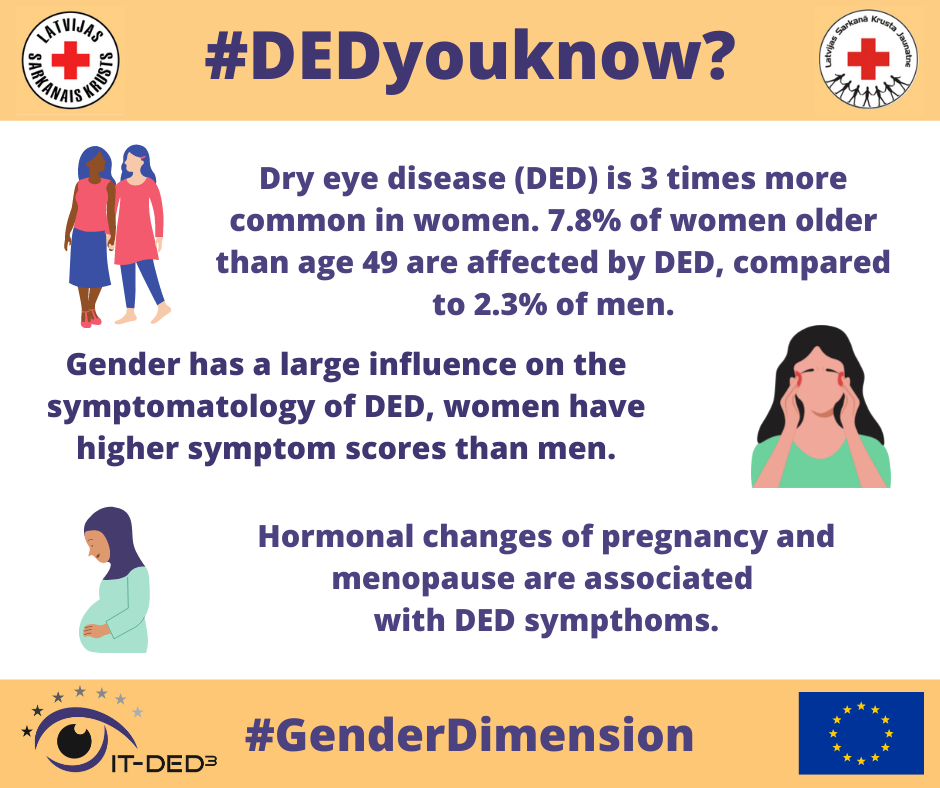
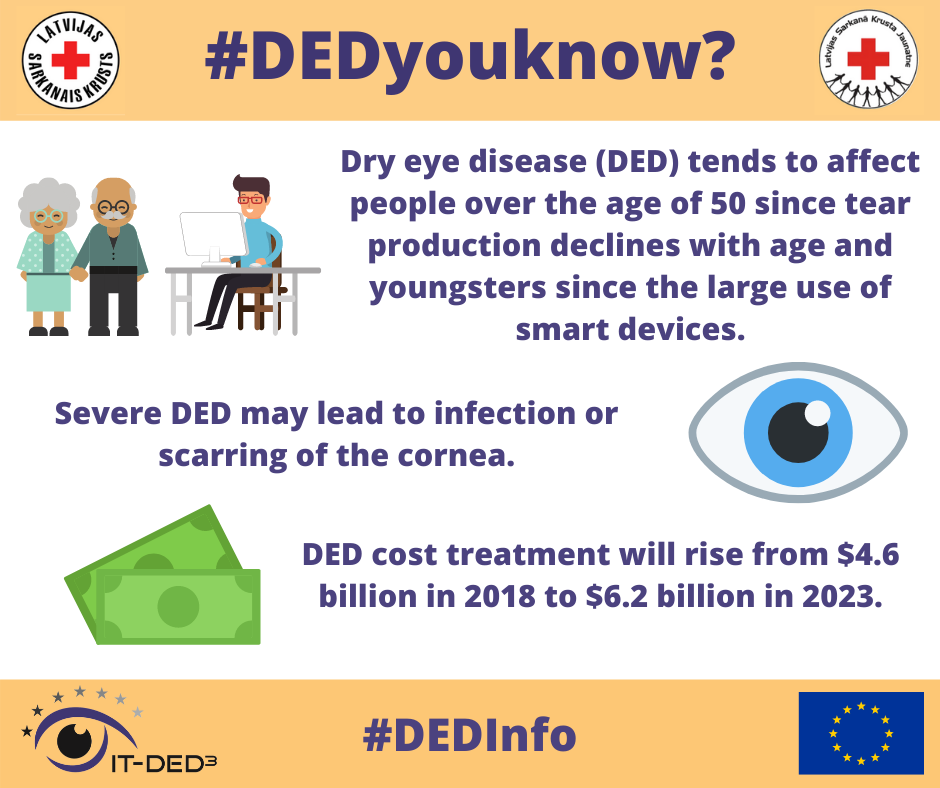
Dry Eye Disease (DED) is a major and increasing health-care problem due to its high prevalence and economic burden. Prevalence data reveals that 5 to 35% of the world’s adult population suffer from DED. It is more common in an older population and three times more frequent in women (7.8% in women older than 49 versus 2.3% in males). 

We invite people to read the information  about DED and take preventive care of their eye health, as well as to see a doctor in case of symptoms.

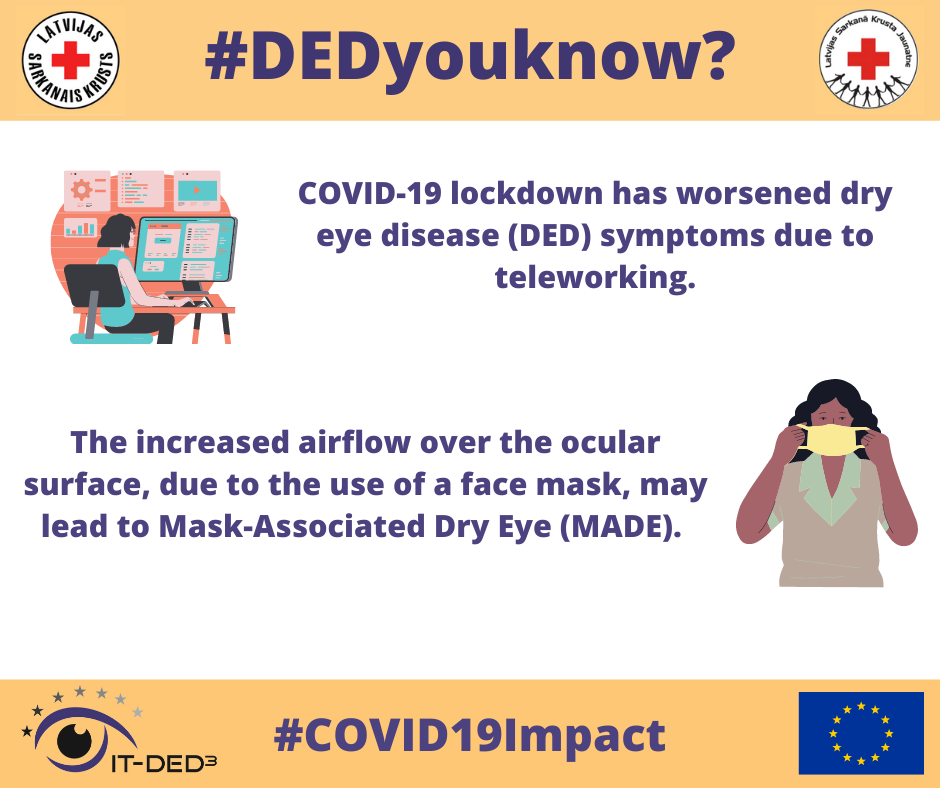
As people are living longer, DED is becoming more prevalent. Moreover, experts expect that the prevalence in the younger population will increase due to frequent computer and tablet screen usage, environmental factors such as dry air, intense air conditioning effects, etc. and wearing of contact lenses. Currently, DED management is based on disease severity and it includes the use of tear substitutes, punctual plugs, autologous serum derivatives, anti-inflammatory therapy, and environmental strategies. 

The main objective of IT-DED3 is to deliver entrepreneurial and innovative researchers able to face future challenges and to convert new ideas into therapeutic products for DED. 

More information about project: https://www.uantwerpen.be/en/projects/dry-eye-disease-drug-development 
Thanks to the volunteers of the Latvian Red Cross Youth Riga devision  Davide Ceradini, Arturs Mietulis and their team for the idea of ​​the campaign and its development, as well – special thanks to M.D. Sandra Baltvilka (RSU) and M.D. Romans Beskrovnijs (RSU).

One of the programs of the Latvian Red Cross Youth is “Health Promotion and Responsibility for a Sustainable Environment”, within it volunteers are developing initiatives that provide support to the society to improve the quality of life.

Tev varētu arī interēsēt:

Strengthening Humanitarian Cooperation: An ICRC Delegation Visit to Latvia

13.02 2026 Uncategorized
From 10 to 12 February, a delegation of the International Committee of the Red Cross visited Latvia. During the visit, meetings were held with representatives of the Latvian Red Cross, the Ministry of Foreign Affairs of Latvia, the Prime Minister’s Office of Latvia, and the Crisis Management Centre of Latvia. The aim of the meetings …

Latvian RC staff strengthens knowledge of international humanitarian law and communication on social media

At the end of October, the Latvian Red Cross  organized a seminar titled “International Humanitarian Law and Communication in Social Media,” which brought together LSK regional committee executive directors, their deputies, project coordinators, program managers, and LSK Youth volunteers. The aim of the seminar was to strengthen knowledge of international humanitarian law (IHL) and to …

Preparing today, we are safe tomorrow: Evacuation exercise held in a flooded area in Riga

25.10 2025 Uncategorized
On 25 October, a two-day practical evacuation exercise concluded, during which a flood scenario with realistic challenges for both residents and involved services was simulated in Riga. The scenario assumed that as the water level rapidly rose in a neighbourhood of Riga, residents were forced to leave their homes and move to a municipal evacuation …

Young people prove – they can react in crisis situations and provide first aid

15.09 2025 First Aid
On 13 September, the Latvian Red Cross (LatRC) organised the National First Aid Competition for school students, which took place in Tērvete Nature Park. The best youth teams from across Latvia came together to compete. This was the grand final of the 2025 competition series – during the previous school year, students had trained diligently …

The Latvian Red Cross, together with the State Fire and Rescue Service, teaches how to set up an evacuation point in a crisis situation.

21.08 2025 Uncategorized
From 19 to 21 August, the Latvian Red Cross, together with the State Fire and Rescue Service and Riga City Council, is training representatives of state institutions, municipalities, and NGOs on how to act in crisis situations when it is necessary to establish and operate an evacuation point. During the training, participants learn: how to …