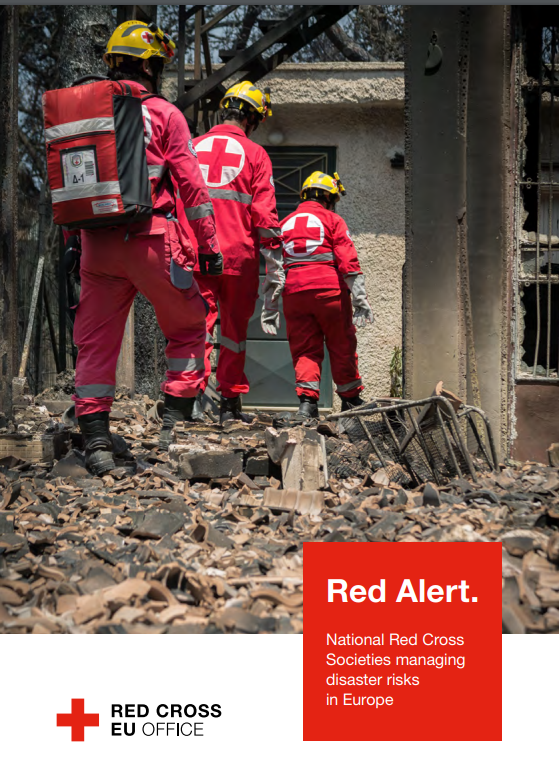
The SK EU Office has published a report “Red Alert. National Red Cross Societies managing disaster risks in Europe”

Europe is facing a changing climate, and rising risks. Some trends are clear: heat, extreme rainfall, droughts and wildfires are on the rise. Recent events often provide a good lens to understand how risks are evolving. The record heatwaves for instance, which featured among the world’s most deadly disasters, show us not just how the climate is changing, but also how our societies are still unprepared to cope with increasing extreme weather events.

The Red Cross EU office has released the report on disaster management “Red Alert. National Red Cross Societies managing disaster risks in Europe”. In includes an overview about the disaster management and planning processes in Europe. In the chapter “Towards smart preparedness planning in the Baltic Sea region” overview about the disaster preparedness planning processes is found. In addition, it indicates how COVID-19 pandemics has shown that disaster preparedness planning processes should be reviewed considering the cross-border and cross-sectoral threats.

More information about the Baltic Sea region disaster preparedness planning and experience of LatRC and other RC national societies of the region is found HERE (31 – 33 pages).

Since January 2029 LatRC implements the international project “BALTPEP – enhancing regional preparedness and response capacity for major accidents in the Baltic Sea region”. The main goal is to improve and optimize quality and interoperability of the Red Cross and Civil Protection Authorities regional response capacity for major accidents and severe disruptions.

The BALTPEP project is implemented in Finland, Denmark, Germany, Poland, Lithuania, Latvia and Estonia.

Tev varētu arī interēsēt:

Strengthening Humanitarian Cooperation: An ICRC Delegation Visit to Latvia

13.02 2026 Uncategorized
From 10 to 12 February, a delegation of the International Committee of the Red Cross visited Latvia. During the visit, meetings were held with representatives of the Latvian Red Cross, the Ministry of Foreign Affairs of Latvia, the Prime Minister’s Office of Latvia, and the Crisis Management Centre of Latvia. The aim of the meetings …

Latvian RC staff strengthens knowledge of international humanitarian law and communication on social media

At the end of October, the Latvian Red Cross  organized a seminar titled “International Humanitarian Law and Communication in Social Media,” which brought together LSK regional committee executive directors, their deputies, project coordinators, program managers, and LSK Youth volunteers. The aim of the seminar was to strengthen knowledge of international humanitarian law (IHL) and to …

Preparing today, we are safe tomorrow: Evacuation exercise held in a flooded area in Riga

25.10 2025 Uncategorized
On 25 October, a two-day practical evacuation exercise concluded, during which a flood scenario with realistic challenges for both residents and involved services was simulated in Riga. The scenario assumed that as the water level rapidly rose in a neighbourhood of Riga, residents were forced to leave their homes and move to a municipal evacuation …

Young people prove – they can react in crisis situations and provide first aid

15.09 2025 First Aid
On 13 September, the Latvian Red Cross (LatRC) organised the National First Aid Competition for school students, which took place in Tērvete Nature Park. The best youth teams from across Latvia came together to compete. This was the grand final of the 2025 competition series – during the previous school year, students had trained diligently …

The Latvian Red Cross, together with the State Fire and Rescue Service, teaches how to set up an evacuation point in a crisis situation.

21.08 2025 Uncategorized
From 19 to 21 August, the Latvian Red Cross, together with the State Fire and Rescue Service and Riga City Council, is training representatives of state institutions, municipalities, and NGOs on how to act in crisis situations when it is necessary to establish and operate an evacuation point. During the training, participants learn: how to …