

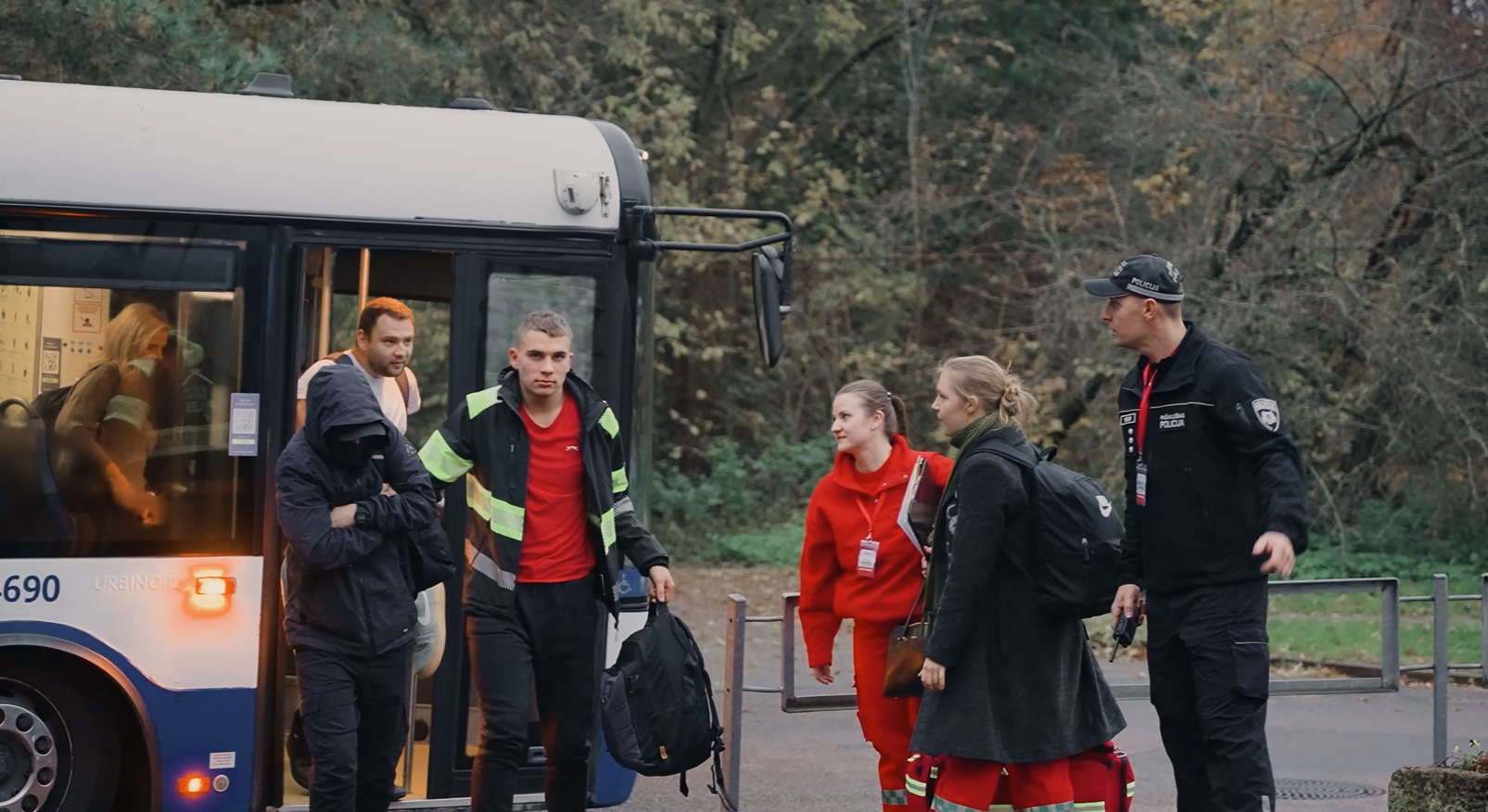
On 25 October, a two-day practical evacuation exercise concluded, during which a flood scenario with realistic challenges for both residents and involved services was simulated in Riga. The scenario assumed that as the water level rapidly rose in a neighbourhood of Riga, residents were forced to leave their homes and move to a municipal evacuation centre established at Riga Secondary School No. 9.
Participants were evacuated from Natālija Draudziņa Secondary School and Riga Arkādija Secondary School, where initial assembly points had been set up. There, residents received instructions, were registered with identification wristbands, and seated in transport to reach safety — the evacuation centre.
At the evacuation centre, intensive and diverse activities took place — registration, arrival flow management, preparation of sleeping areas, a first aid point, and support for people with different needs. Under the cover of night, situations typical of real emergency conditions were simulated: health problems, emotional crises, and the need to respond to unexpected events. In one episode, due to a participant’s deteriorating health condition, an emergency medical service team had to be called to provide assistance and ensure transportation to a hospital. Such cases allowed testing both staff and service response speed and coordination.
Additionally, practical first aid sessions were conducted, and participants were reminded about the “72-hour bag” — an essential preparedness element for every resident. Participants had the opportunity to experience situations requiring quick decision-making, helping others, and adapting to uncomfortable environments that may become reality during an evacuation.
These exercises helped test not only technical and logistical processes but also people’s resilience, ability to cooperate, and capacity to remain calm in conditions closely resembling a real crisis environment. This is an important step toward improving overall preparedness and ensuring that when it is truly needed, the system operates in a coordinated, safe, and effective manner.
We thank every resident of Riga who participated in the exercise, as well as our partners — the State Fire and Rescue Service, the Emergency Medical Service, and the Riga City Municipality Civil Protection and Operational Information Administration — for their professional cooperation and support.
The training is implemented within the framework of the project “Baltic Civil Protection Cooperation for Complex Emergencies.”
Together we are building a safer and more resilient society.
Apmācības tika īstenotas projekta “Baltijas civilās aizsardzības sadarbība sarežģītām ārkārtas situācijām” ietvaros, stiprinot sadarbību starp atbildīgajiem dienestiem un iedzīvotāju drošību ārkārtas situācijās.
Saistītie raksti
LSK kopā ar VUGD māca, kā krīzes situācijā izveidot evakuācijas punktu